
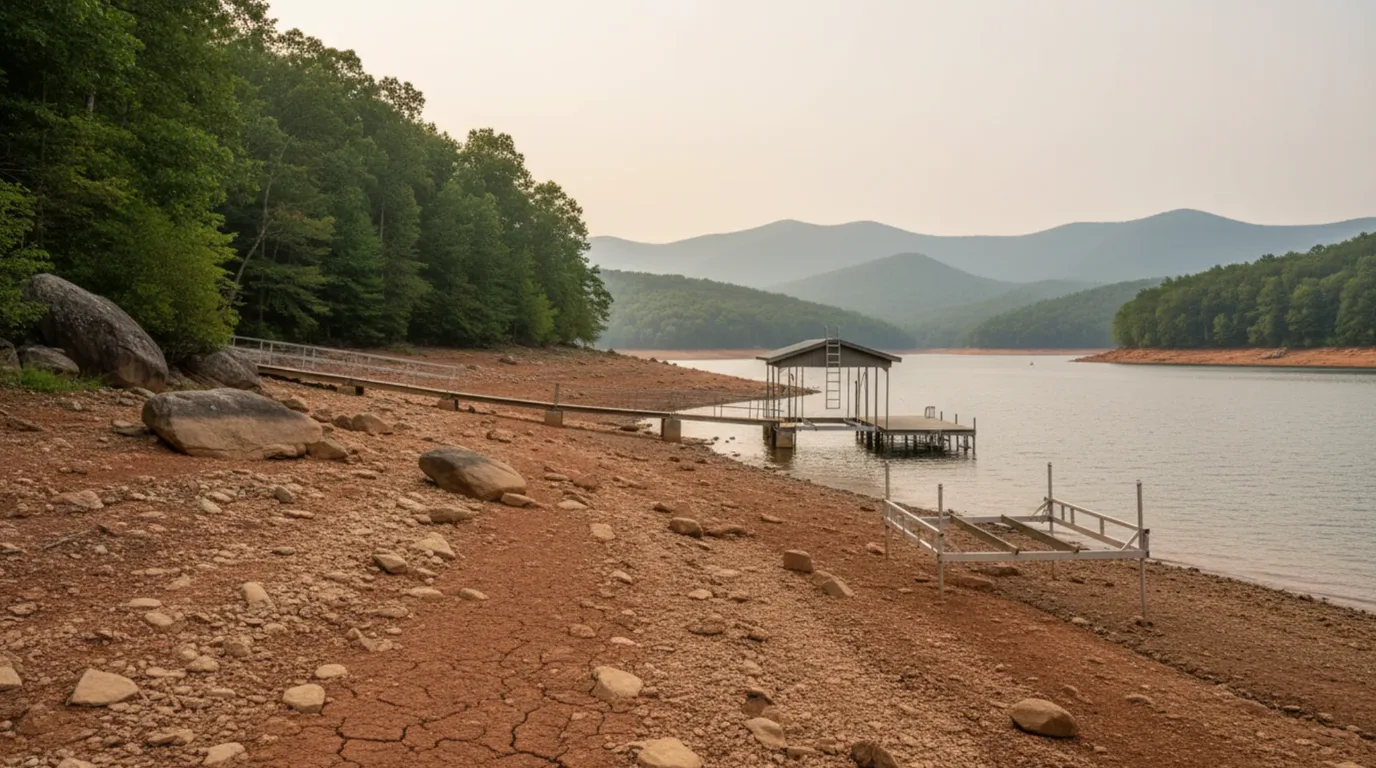
The Smith Mountain Lake Association's October 2, 2026 update reports discussions about changing the Water Management Plan but announces no adopted changes. Appalachian Power runs the lake under its FERC license, and that license does not set a minimum lake level for recreation. Lake stakeholders have met with APCo to push for changes, and the company has promised a public meeting before the end of the year. If you own here or are buying here, the thing to watch is that meeting date, plus how your specific dock and cove behave when the water is down. For the practical side of low water, see my August post What a Drought Emergency Means for Smith Mountain Lake Property Owners.
Who decides how low Smith Mountain Lake goes?
Appalachian Power operates Smith Mountain Lake under a FERC-regulated Water Management Plan that includes drought triggers (WDBJ7, May 19, 2026). When the lake gets low, APCo can pull back on outflows from Leesville Dam, but the license does not require the company to keep the lake at any particular level for boating, fishing, or dock use. The same WDBJ7 report put it plainly: the license sets no minimum lake level for recreation. That is the sentence that matters.
APCo says it tries to keep the lake at full pond. Joshua Blake, its hydro-generation maintenance superintendent, told the station, "Obviously, it would be in Appalachian Power Company's best interest if the lake was at full pond." The spokesperson, Izzy Post Ruhland, put the limit in one line: "Our fuel supply is what Mother Nature gives us." Operations follow a predictive model that tracks inflows and outflows. WSLS 10 News (June 24, 2026) described the plan the same way: it runs on water availability and inflow, not a fixed lake elevation.
How did the drought triggers play out in 2026?
| Date (2026) | What happened | Source |
|---|---|---|
| April 27 | Trigger one: APCo reduces outflows from Leesville Dam | WDBJ7, May 19 |
| May 11 | Trigger two: outflows cut again | WDBJ7, May 19 |
| June 16 | Lake reported around 790 feet, about five feet below normal | WSLS, June 24 |
| July 13 | More than five feet below full pond | WDBJ7, July 13 |
| Sept 17 | Nearly 6 feet below pond level as heat drives power demand | WSET, Sept 17 |
| October 2 | SMLA reports stakeholder meeting with APCo; public meeting promised before year end | SMLA, Oct 2 |
The plan has drought triggers. Trigger one hit on April 27, 2026, and APCo reduced outflows from Leesville Dam. Trigger two hit on May 11, and outflows were cut again. A third trigger was still available if conditions worsened; the May report did not say it had been used. By that point APCo was releasing the minimum water legally required from Leesville Dam.
The area was in a 12-month drought, its worst since 2007. At a June 16 meeting with the Franklin County Board of Supervisors, the lake was reported at around 790 feet, about five feet below normal, WSLS 10 News reported on June 24. Kyle Draper, communications manager for Bedford Water, told WSLS it had been nearly 20 years since the lake was this low.
By mid-July the lake was still more than five feet below full pond (WDBJ7, July 13, 2026). Smith Mountain Lake Fire and Rescue Deputy Chief Ray Talley told the station that reaching full pond would take about 14 inches of rain, which he called unlikely to fall all at once, and that raising the lake one inch takes about 530 million gallons of water.
Then September brought heat and power demand. WSET reported on September 17, 2026 that the lake had fallen nearly 6 feet below pond level, and some boats could not reach the water from their docks. "Temperatures are hot, folks are using more energy, so we're using the turbines more frequently," Appalachian Power told the station. Water released for generation flows to Leesville Lake, and APCo told WSET it can pump water back when generation is not needed.
Has anything changed this fall?
In its Lake Level Update dated October 2, 2026, the Smith Mountain Lake Association (SMLA) reported that it had convened a meeting between lake stakeholders and APCo to advocate for changes to the Water Management Plan. Attendees included SMLA, the Tri-County Lakes Administrative Commission, the SML Chamber of Commerce, the Leesville Lake Association, the Virginia Department of Environmental Quality, and the Virginia Department of Wildlife Resources.
SMLA called the discussion productive and said stakeholders want to protect Smith Mountain Lake from future droughts, but added that "the process will take time." SMLA said it will keep a seat at the table. APCo will host a public meeting before the end of the year. The date will be posted on the SMLA website and Facebook page once it is set.
SMLA's October 2 update announces no adopted changes and gives no proposal details. We do not know what changes will be asked for, what APCo will agree to, or whether any change would affect lake levels during the next hot, dry stretch. All we know is that the conversation has started and a public meeting is coming.
What should owners and buyers watch before the public meeting?
Watch the SMLA website and Facebook page for the public meeting date; SMLA says that is where it will be posted. Appalachian Power's own project site, SmithMountainProject.com, is where WSLS pointed readers for operations updates. If you want the practical side of low water, wells, restriction lists, and how to walk a dock when the lake is down, I covered that in my August post.
For a specific property, ask how the dock, slip, and cove approach work when the lake is low. Ask how the dock sits at six feet below pond. Ask whether the boat can still float at the slip, or whether the approach channel cuts too shallow. Ask where the cove narrows and where the bottom comes up. A dock that looks fine at full pond can be a different animal at low water. The plan does not guarantee you will not see low water again. If you are shopping this fall, look at the current Smith Mountain Lake homes for sale in person and see each dock as it sits that day, not as it looks in the listing photos.
My honest read
I have been selling around this lake for 21 years, and I have seen it high and low. I am glad stakeholders got in the room with APCo. The meeting is a starting point, not a change in the operating rules. Until a change is proposed and approved, the license says what it says. If you are buying, do not assume the lake will always sit at full pond. If you are selling, be ready to explain how your dock handles the downside; our seller guide covers how we prepare a listing for those questions. Call me if you want to walk a specific property and talk about what low water looks like there.
Sources
- WDBJ7: "APCO adjusting operations of SML dam due to low water levels," May 19, 2026
- WSLS 10 News: "Appalachian Power provides update on Smith Mountain Project amid ongoing drought conditions," June 24, 2026
- WDBJ7: "Smith Mountain Lake remains more than five feet below full pond, creating hazards for boaters," July 13, 2026
- WSET: "Smith Mountain Lake water levels fall nearly 6 feet as heat drives power demand," September 17, 2026
- Smith Mountain Lake Association: "Lake Level Update," October 2, 2026