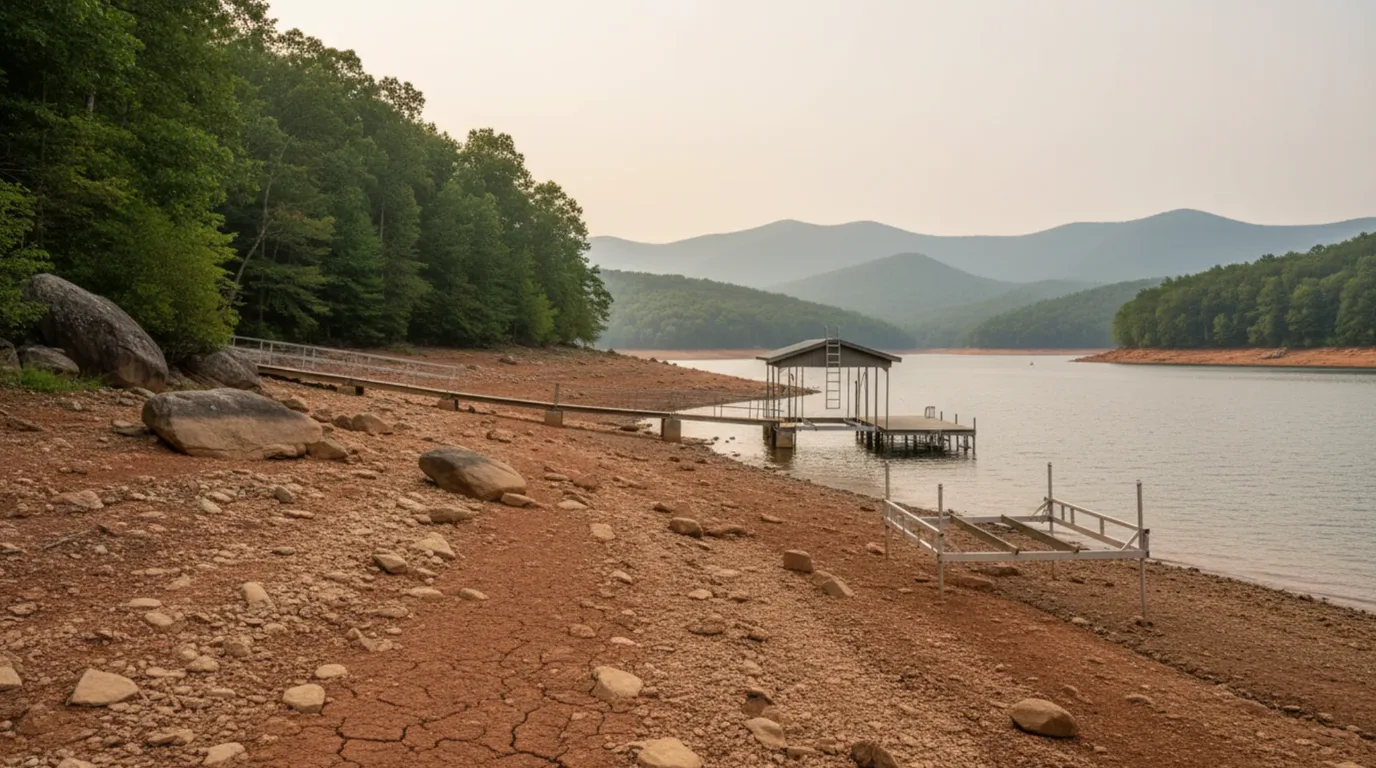
On July 7, 2026, Virginia's Drought Monitoring Task Force recommended a drought emergency for the Roanoke Drought Evaluation Region. Nine days later, on July 16, 2026, Governor Abigail Spanberger stepped to a podium at Smith Mountain Lake, in Bedford, to lay out where things stand.
That recommendation is the headline. Here is what it changes for owners and buyers around this shoreline.
What Emergency Status Actually Means
A recommendation from the task force is a procedural step. The region, as named in the update, includes Bedford, Campbell, Charlotte, Franklin, Halifax, Henry, Mecklenburg, Patrick, Pittsylvania, and Roanoke counties, and the cities of Danville, Martinsville, Roanoke, and Salem, and it has reached emergency status. Mandatory non-essential water use restrictions are not in effect right now. What is published, in advance, is the list of activities that restrictions would cover, and the Governor's update spells that list out in plain language.
The list, as published in the update:
- Irrigation of lawns, gardens, and landscape materials
- Irrigation of golf courses
- Irrigation of athletic fields
- Washing of paved surfaces, including streets, roads, sidewalks, driveways, garages, parking areas, tennis courts, and patios
- Washing or cleaning of mobile equipment, including automobiles, trucks, trailers, and boats
- Operation of ornamental fountains, artificial waterfalls, misting machines, and reflecting pools
- Filling and topping off outdoor swimming pools
A formal emergency declaration, which is the step that would switch on mandatory restrictions, has not been made. If it is, the Department of Environmental Quality will also require industrial water users to reduce water withdrawals. That part matters if you are buying a property with a small commercial use, or near one. Virginia's Drought Assessment and Response Plan has been in effect since 2003, so the framework itself is not new. What is new is the regional trigger pulling this part of the state into emergency status.
The numbers around the lake are stark. Smith Mountain Lake was 5.5 feet below normal at the July 16 update. John Kerr Reservoir was 4.45 feet below normal on the same date. Rain across the Commonwealth is about 7.8 inches below normal, making this the second driest water year on record. The Roanoke Drought Evaluation Region has only received 57 percent of its normal rainfall. Surface water flow is below the 5th percentile. Groundwater is below the 5th percentile, and many wells are setting provisional daily low records. The DEQ maintains a Drought webpage and an interactive Drought Dashboard that tracks stream gages, groundwater wells, soil moisture, and precipitation. I watch those dashboards the way I watch the radar in storm season.
Translated Into Lake Life
This is where the list stops being a news story and starts being a chore chart.
Lawn and landscape irrigation is a habit around here, not a luxury. People water their beds, top off the lawn on a hot July weekend, run drip lines on the new plantings. Under mandatory restrictions, that whole rhythm stops. Most owners should plan for brown yards in August. If you have invested in new sod since spring, the irrigation company is the first call to make. Some pause service contracts the moment a declaration lands. Others send a tech out to shut the system down.
Boat washing is on the list. After a weekend on the water you come home with a green streak down the hull, and you are used to rinsing it off. Under mandatory restrictions, the driveway rinse is off the table. A bucket wash may still be allowed. The exact rule is set by the locality when the time comes, so check what your county or town has posted before you do anything. The next item on the restriction list sounds minor until you live here. Washing of paved surfaces. That means no hosing down the driveway after a weekend of boat trailers and foot traffic. No rinsing the patio where everybody dripped lake water and sunscreen all afternoon. No power washing the sidewalk or the parking pad. Around this lake, that is a summer habit. You come up from the dock, you rinse the concrete, you move on. Under a mandatory restriction, that stops.
Then there are ornamental fountains, artificial waterfalls, and misting machines. A lot of lake houses have a small fountain in the landscaping or a waterfall feature near the patio. Some have misting systems on the porch for the really hot days. Those would shut off. They are not essential. But they are part of how people use their outdoor space from June through September, and losing them changes the feel of an evening on the deck.
The one that gets people's attention is swimming pools. Filling or topping off outdoor swimming pools would be prohibited under a mandatory restriction. A lot of houses around Smith Mountain Lake have pools. Not every house, not even most, but enough that it matters. A pool in July loses water to evaporation, to splashing, to backwashing the filter. You top it off weekly, sometimes more often in a hot stretch. If you cannot add water, the level drops. The pump can run dry. The chemistry gets impossible. You are looking at potential equipment damage and a pool that may need to be partially drained to protect the system. If you are buying a house with a pool this year, ask the seller how they have been managing it through dry periods. Ask whether the pool has a cover. Ask whether they have a well or municipal water feeding it, because that answer changes everything about pool ownership in a dry year.
Wells and Municipal Water Are Two Different Problems
This one matters more than people realize. A large share of properties around this lake run on private wells rather than municipal water. I have never seen a published count for the lake, and I am not going to invent one, but in twenty one years of showing houses here it has come up constantly. If you are on municipal water, a mandatory restriction is a set of rules you follow. If you are on a well, you are dealing with something else entirely.
The July 16, 2026 drought update from the Governor of Virginia put it plainly. "Groundwater levels continue to be depleted in the region. Many groundwater wells in the Roanoke Drought Evaluation Region continue to set provisional record daily low water levels. Groundwater levels in the Roanoke Drought Evaluation Region are below the 5th percentile. The long-term outlook for groundwater levels remains a concern and will take a prolonged period of additional rainfall to recover."
That is a description of what is happening underground right now. Dwayne Roadcap, who directs the Virginia Department of Health Office of Drinking Water, said, "We have a lot of hardworking people at the municipal plants who are doing really good work, monitoring groundwater levels, monitoring reservoir water levels, and monitoring stream flow." Brian Key, Executive Director of the Bedford Regional Water Authority, put it this way: "Water isn't just something that's fun to play in or something that improves the quality of our life. It's the very essence of life itself." Senator Mark Peake, at the same press conference, was blunter: "Water is a precious resource, and it is short right now."
The difference is worth spelling out. Mandatory restrictions are written for public systems. They tell you what you can and cannot do with water that comes through a pipe maintained by a utility. A well that goes low is the owner's problem and the owner's bill. If your well pump starts sucking air, you are not calling the water authority. You are calling a well company, and you are paying for that visit yourself. Deepening a well is not a small bill.
The Dock, the Lift, and the Shoreline
This is where twenty one years of living on this shoreline matters, and I am going to give you my judgment rather than a report.
Two docks on the same lake, at the same reading, can be nothing alike. Two houses a mile apart can tell completely different stories at the same lake level. The same lake reading can mean comfortable depth at one dock and almost nothing at another a short distance away.
Listing photos are taken at full pond on a good day. That is just what happens. Nobody photographs a dock at low water in October if they can photograph it in May when the lake is up and the light is right. But the photo does not tell you what late August looks like.
Boat lifts, floating docks, and swim platforms each behave differently as water drops. A floating dock follows the water down. A fixed dock does not. A boat lift that worked at full pond may have its cradle sitting in mud at low water. A swim platform that was waist deep in June may be ankle deep in September.
What should a buyer physically do this year? Go to the property. Walk the dock. Look at the water depth at the end of the pier and at the lift. Go now, while the lake is down. If you are serious about a house, ask to see it at low water before you make an offer, and pay attention to how the seller reacts to being asked.
What I Am Telling Sellers
I am telling sellers to be honest about what the dock looks like right now. If your cove is shallow and the water is low, do not hide it. Take current photos. Put them in the listing or at least have them ready. Disclose anything related to the well, the pool, the dock, the lift. If the pump has been struggling, say so. If the lift needs adjustment at low water, say so.
Timing matters. If you list in early spring when the lake is full, you will get buyers who fall in love with the view and the dock and the water depth. If they come back in August and the dock is in mud, they will renegotiate or they will walk. A buyer who walks the dock at low water and buys anyway is a buyer who does not come back to renegotiate in August, which is worth more to a seller than an extra week of pretty photographs.
My Honest Read
Should any of this change your decision to buy at Smith Mountain Lake? I do not think it should, but I think you should go in with your eyes open. I have watched the lake drop and recover more than once in two decades. It will recover again. But Virginia Farm Bureau Federation President Scott Sink said, "We've been feeling the effects of the drought in this area since 2025," and I take that seriously. This is not a one-season blip. It may take longer than any of us want.
What I tell people is this. Buy the lake house. Buy it for the long haul. But walk the dock at low water first. Know what you are getting. Know what the well is doing. Know what the pool will cost you in a dry year. Then make your decision. If you want a second opinion on a specific dock, call me. I will tell you what I would tell a friend, including when the answer is to keep looking.
Questions to ask before you write an offer this year
- Is this property on a private well or municipal water?
- Has the well had any issues with low water levels in the past two years?
- Does the house have a pool, and how has the owner managed water levels during dry periods?
- What does the dock look like at current lake levels, not just at full pond?
- How deep is the water at the end of the pier and at the boat lift right now?
- Is the dock fixed or floating, and how does that affect access as the water drops?
- Has the seller noticed any change in water depth at the shoreline over the past year?
- What water restrictions are currently in effect for this property's water provider?
The lake will tell you the truth if you walk down to it and listen.
Sources
Every factual claim above comes from one of these primary sources.
- Office of the Governor of Virginia, Governor Spanberger, State Leaders Provide Update on Response to Drought in Roanoke Region, July 16, 2026
- Office of the Governor of Virginia, Governor Spanberger, Roanoke Region Leaders Urge Increased, Commonsense Water Conservation Efforts, July 15, 2026
- Office of the Governor of Virginia, Governor Spanberger Encourages Commonsense Water Conservation in Response to Historic Drought Conditions, June 18, 2026
- WDBJ7, Smith Mountain Lake remains more than five feet below full pond, creating hazards for boaters, July 13, 2026
- WDBJ7, Business owners discuss the impacts of low water levels at Smith Mountain Lake, June 2, 2026